Peptide Pureness Overview 98%, 99% & Research-grade Explained Prg
Peptide Purity Evaluation Service
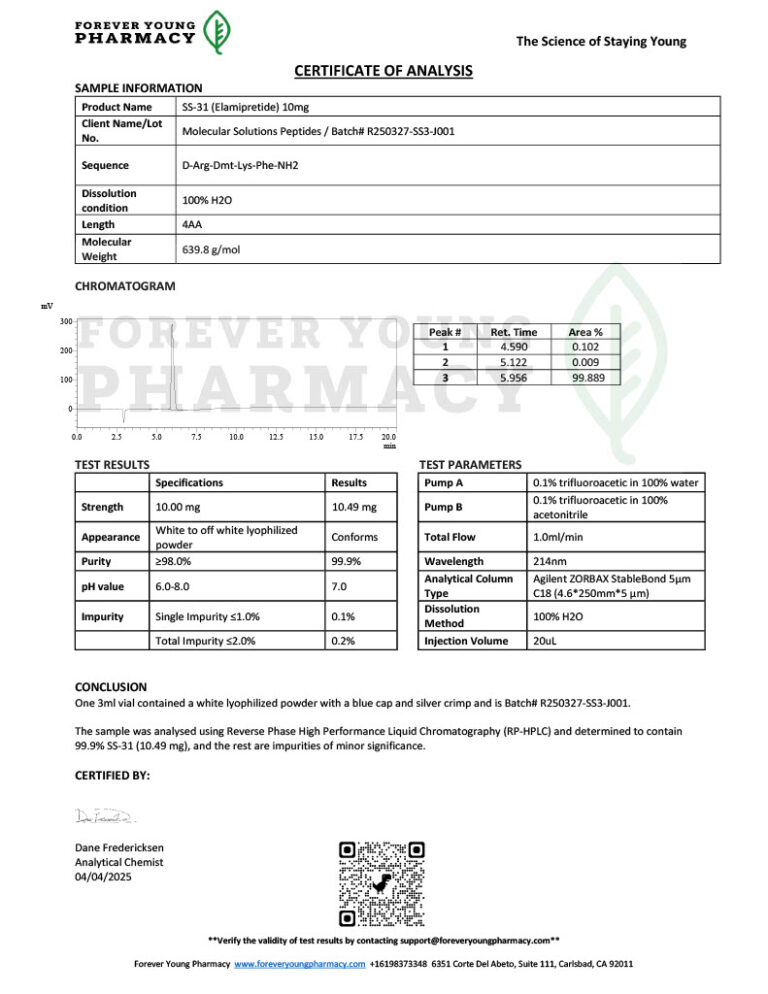
In vivo examinations evaluate absorption, distribution, metabolism, and excretion (ADME) features, additionally verifying efficiency and security. These screening services not only aid customers enhance items precisely during development yet likewise supply solid information support for regulative conformity of peptide solutions. Be cautious of COAs that give a pureness number without any sustaining chromatographic information, record pureness without specifying the analytical technique, or list a molecular weight without mass spectrometry verification. Tandem mass spectrometry (MS/MS or MS ²) pieces the peptide ions in the gas stage and analyses the fragment masses. This is the gold criterion for peptide identification-- it verifies both the make-up and the series. For lots of peptide tasks, outright peptide amount matters as long as chromatographic pureness.- The chromatogram is one of the most essential aesthetic information component on an HPLC peptide examination report.
- Asparagine and glutamine deposits can undertake deamidation, altering the peptide's charge and hydrophobicity.
- Throughout solid-phase synthesis, each amino acid coupling step has a return of approximately 99-- 99.8%.
- This is the gold requirement for peptide identification-- it validates both the composition and the sequence.
- A modern-day HPLC system contains a number of incorporated parts, each serving a details function in the splitting up and discovery procedure.
- Subtle differences in raw material pureness and framework can result in inconsistencies in the activity of the end product.
Frequently Asked Concerns (Frequently Asked Questions) Concerning Research Laboratory Validation In Peptide Research
We sustain amino acid structure evaluation and internet peptide material examination for groups that need more reliable concentration setup and batch interpretation. HPLC-tested means the example was gone through high-performance fluid chromatography to divide the target peptide from impurities. The purity portion is usually determined from the major optimal area split by the total incorporated height location.
Imaginative Peptides suggests a collection of different pureness degrees to assist you choose the ideal peptide purity for peptide-based assays and applications. The adhering to listing reveals the suggested peptide pureness levels required for different peptide applications. Peptide recognition is mostly carried out using mass spectrometry (MS), which offers accurate measurements of peptide molecular weight. Furthermore, strategies such as amino acid evaluation and HPLC are utilized to verify the peptide's identification and purity, making certain exact characterization for numerous applications. We give peptide identity confirmation making use of mass-based techniques selected for the example and analytical objective. This is important when the main inquiry is whether the observed component matches the desired peptide or whether an adjustment has been included as expected.Where Can I Acquire Lab Evaluated Peptides?
Unlike a supplier's internal testing, independent third-party laboratory validation is neutral and gives unbiased results, including reputation through unbiased logical information. This procedure is crucial for keeping high peptide high quality since the peptide market is mostly uncontrolled in several places, and without recognition some distributors may use impure, mislabeled, or perhaps counterfeit peptides [3] Guaranteeing that each set undergoes proper laboratory testing helps verify the peptide's credibility and purity, which is vital for both research study credibility and safety and security. Peptide pureness refers to the percent of your sample that is the correct, full-length peptide series, free from other peptide-related impurities. For instance, a purity of 98% indicates that 98% of the peptide material is the intended product, while the various other 2% may be unwanted remnants of synthesis (such as incomplete series or amino acid deletion variations).A sample could generate a clean-looking chromatogram with one leading peak and still be the incorrect substance if identification was never ever confirmed. HPLC actions splitting up and loved one peak area; mass spectrometry steps mass-to-charge behavior that can be used to validate molecular identity. Peptide purity screening is the procedure of verifying that a peptide example has just the designated sequence-- and no considerable impurities or byproducts from synthesis. Due to the fact that peptides are created via complicated chemical processes, trace impurities can develop normally. Checking enables scientists to recognize precisely what remains in the vial, validating both identity and top quality. Choosing a respectable third-party laboratory is key to getting dependable peptide validation results.We utilize GC-MS, ICP-MS, and various other techniques to spot impurities, making sure item safety and regulative conformity. Peptide sequencing is vital for recognizing the exact amino acid sequence of peptides, consisting of modifications like phosphorylation or acetylation. Sequencing allows researchers to recognize the biological role of the peptide and its interaction with other particles, aiding in the layout of useful peptides for varied applications. The peptide example is liquified in a suitable solvent and filled into an autosampler.
A useful assay determining downstream signaling-- or a structural research study using NMR or X-ray crystallography-- requires the greatest pureness available. Crystallographers in particular often require ≥ 98% pureness since also minor impurities can prevent crystal development or introduce condition into the crystal latticework. As molecules exit the column, they travel through a detector-- commonly a UV detector set to 214 or Pharma Grade Store lab supplies 220 nm, wavelengths where the peptide bond takes in light strongly. The detector records just how much UV light is absorbed with time, producing a graph called a chromatogram. This overview breaks down what purity really means in peptide chemistry, how it's gauged, what the contaminations are, and just how to check out the paperwork that confirms a peptide is what it claims to be. Desalted peptides function well for ELISA covering, some cell-based assays, and applications where modest purity is acceptable. After synthesis and purification, peptides are normally lyophilized (freeze-dried) as salts. One of the most usual counterion is trifluoroacetate (TFA) from the HPLC filtration solvents, though some peptides are provided as acetate or hydrochloride salts. These counterions aren't "pollutants" in the HPLC sense-- they don't turn up as separate tops-- yet they do add to the overall mass of the powder.